


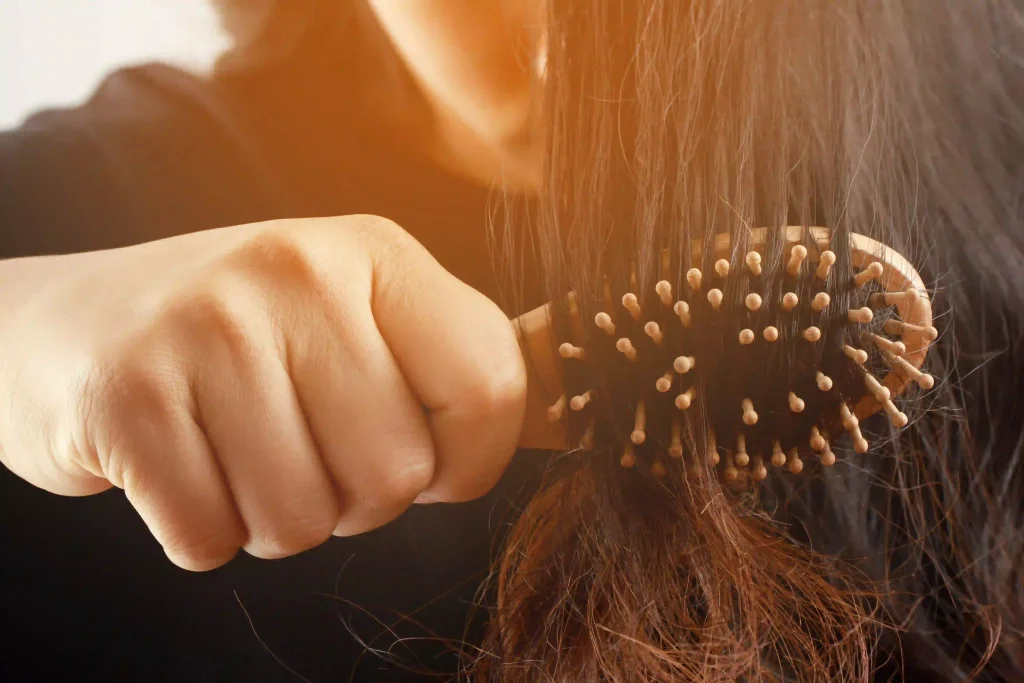
You run your fingers through your strands hoping for silk, but instead, you hit a rough snag. Many of us have stared into the mirror asking, “Why does my hair feel like straw?” That friction isn’t just dryness; it is a warning signal that the physical structure of your hair has changed.
Healthy hair relies on the cuticle, an outer layer that behaves like shingles on a roof. When these microscopic scales lie flat, they protect the delicate inner core known as the cortex. Unfortunately, styling heat and friction often force these protective shingles to lift or peel away.
Once this barrier is compromised, gaps form that allow moisture to escape instantly—one of the clear signs of high hair porosity. To effectively treat damaged hair, we must look beyond surface oils and address the biology underneath.
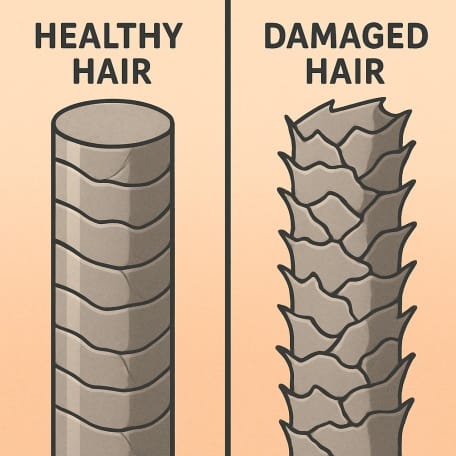
Porosity is simply a measure of how open or closed your cuticle shingles are. When the scales are lifted too high, your hair acts like a sponge that absorbs moisture but loses it just as quickly. Knowing where you stand is essential to fix damaged hair effectively.
You don’t need a lab coat to figure this out; a simple experiment reveals the truth about your structure:
If the strand sinks rapidly, your cuticles likely have gaps and tears, meaning your hair absorbs liquid too fast. Floating strands indicate a tighter, healthier cuticle layer that is better at self-defense. Once you identify that your hair structure is compromised, preventing further breakage becomes your top priority. This makes understanding the difference between passive oils and active shields, like heat protectants, absolutely vital.
If you discovered that your hair sinks in water, your cuticle “shingles” are already open and vulnerable. Applying a heat protectant isn’t just an optional step; it creates a necessary thermal barrier that acts as a sacrificial layer between your tools and your cortex. While oils are excellent for finishing, the debate regarding heat protectant spray vs serum effectiveness favors sprays for hot tools because they utilize evaporative cooling to disperse high temperatures before they scorch the cuticle.
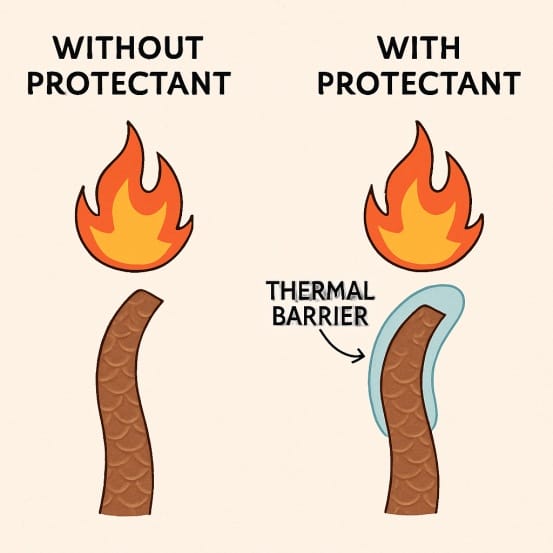
Hearing a sizzle when your flat iron touches a section is a warning sound you shouldn’t ignore. That noise is moisture trapped inside the hair shaft boiling instantly, expanding into tiny steam pockets that rupture the strand from the inside out—a permanent deformity stylists call “bubble hair.” Recovering from bleach and heat styling is impossible if you are constantly exploding the inner structure of your hair by styling while damp.
Water fundamentally alters your hair’s elasticity, making it dangerously stretchy. Since wet strands can stretch up to 50% of their length before snapping, rough towel drying or aggressive brushing is a primary cause of mechanical damage hair issues. To avoid unnecessary breakage, blot excess water gently and ensure hair is 80% dry before introducing high tension.
Shielding the outside is only the first step in stabilization. Once you stop the daily cycle of burning and snapping your strands, you are left with the task of rebuilding the internal structure. Just like a crumbling wall needs more than just water to stand tall, your regimen requires a specific balance of structural materials.
Imagine your hair structure as a brick wall. Protein acts as the solid bricks providing strength, while moisture serves as the flexibility allowing the wall to shift without collapsing. Achieving the right protein vs moisture balance for brittle strands is critical; too much hydration makes hair mushy and weak, while excess protein causes it to snap like a dry twig.
Identifying the specific needs of your hair requires feeling your strands while they are wet to check for these signs:
For hair compromised by bleach or dye, surface conditioners often aren’t enough. This is where bond building technology for chemical breakage becomes essential. Unlike traditional masks that simply coat the outer cuticle to fake smoothness, these formulas penetrate deeper to patch structural “holes” in the cortex, acting as a reinforcement crew for your hair’s internal scaffolding.
Be careful not to confuse “softness” with “health.” Over-conditioning creates a fragile structure that cannot hold its own shape, leading to further breakage. Once you have stabilized the internal bonds, your next priority is ensuring your shampoo doesn’t strip away this hard-earned progress.
Even the strongest internal bonds cannot survive harsh detergents if you scrub them away daily. Traditional cleansers often act like dish soap, stripping the natural oils your cuticle needs to lay flat. Switching to gentler formulas ensures you aren’t undoing your repair work, allowing specific sulfate-free shampoo benefits for dry textures—like retained hydration and reduced friction—to finally take effect.
Once your hair is clean, you might still see fraying at the tips. While the only permanent cure is a trim, you can improve appearances with serums containing polymers. These ingredients act like a temporary zipper for your strands, sealing the cuticle to stop the fray from traveling upward. This approach effectively buys you time between salon visits by keeping your style polished.
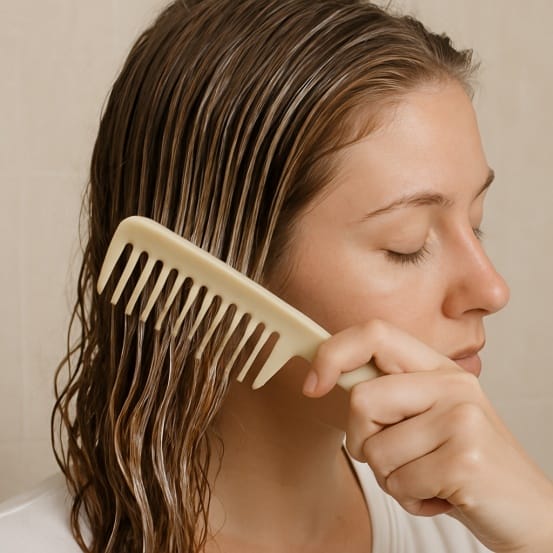
Wet hair is at its most vulnerable, so aggressive brushing often causes as much damage as heat styling. To avoid this, always saturate your hair with conditioner to create “slip” before you even pick up a tool. By starting at the bottom and working your way up, you are preventing mechanical stress during detangling, ensuring knots unravel gently instead of tightening into breakage points.
Protective handling keeps your existing strands safe, yet the environment exerts invisible pressure every time you turn on the tap.
Sometimes the culprit isn’t your routine, but the water itself. If strands feel coated regardless of conditioning, you may be battling the effects of hard water on cuticle health. Heavy minerals like calcium and magnesium act like the chalky film on a shower door, blocking moisture from penetrating and leaving hair stiff.
While managing the lengths, you must also tend to the source. Think of your scalp as the soil; if it is inflamed or clogged, it cannot support strong production. A balanced scalp health impact on new growth ensures emerging hair is robust rather than pre-weakened.
Internal fuel is just as critical for building structure. Incorporating essential vitamins for strengthening weak follicles can fortify strands before they surface:
With the foundation set, we can focus on the daily habits that seal the deal.
You no longer need to guess why your strands feel brittle. By understanding your porosity, you can select ingredients that structurally reinforce the cuticle rather than just coating it. Since biological healing isn’t possible, focusing on reinforcement is the only way to effectively repair damaged hair. This shift empowers you to stop chasing marketing miracles and build a routine that actually works to restore hair health.Start with three simple changes: swap your cotton towel for microfiber, lower the shower heat, and add a weekly treatment. These healthy hair tips reduce friction immediately. With consistency, you will transform frustration into manageability, revealing smoother, stronger strands.