



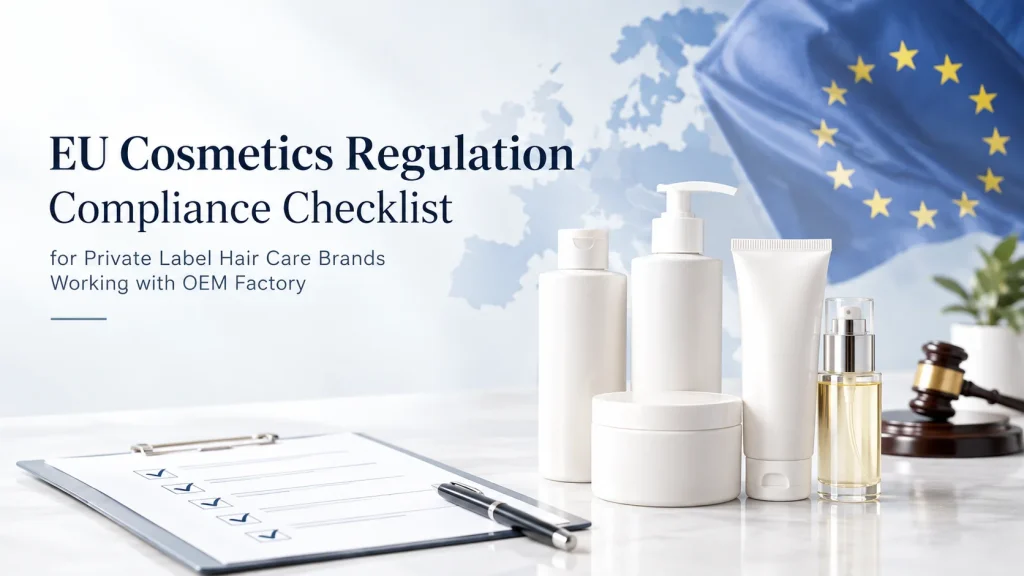
Launching your private label hair care products into the EU market sounds straightforward with an OEM partner — but EU Cosmetics Regulation (EC) No 1223/2009 sets strict legal obligations that many new hair brands overlook.
A common misconception: your OEM factory makes the product, so the factory handles all EU compliance. This is not true. When you put your brand name on the bottle and sell it in the EU, you take on critical brand-side responsibilities, even for white-label stock formulas. Missing one compliance step can lead to CPNP rejection, border hold, product recalls, fines or forced removal from EU marketplaces.
This guide breaks down exactly what private label hair care brands need to prepare before mass production and launch, and clarifies the split of work between your brand and your hair care OEM supplier.
At the core of EU cosmetic compliance is the EU Responsible Person (RP), required for every cosmetic product placed on the EU/EEA market under Article 4 of Regulation 1223/2009.
The RP must be a legal or natural person established inside the EU. Their key duties include:
For most overseas private label hair brands working with an offshore OEM factory: the brand itself is not the RP unless your company has an EU registered entity. You must appoint a third-party EU Responsible Person via a written mandate before you go live.
Important fine print for private label: Even if you use the OEM’s existing base formula, the CPSR and RP arrangement belonging to another brand cannot be reused for your brand. Each branded product needs its own compliance package. Your OEM can supply formula data, raw material specs and batch safety data, but they do not automatically become your EU Responsible Person.

The CPSR is the safety backbone of your hair care product. It is split into two parts:
For hair products, assessors pay extra attention to:
Your OEM factory provides supporting technical files: formula, COA, stability reports, compatibility testing. The brand and RP arrange the qualified safety assessor to review this data and issue your brand-specific CPSR. No valid CPSR = no legal EU launch.
The PIF is the full compliance dossier authorities can request at any time. It must be kept available at the RP’s EU address and retained for 10 years after the last batch is placed on the market.
A complete PIF for private label hair care includes:
Your OEM will supply manufacturing and formula evidence; your RP organises the full PIF assembly and ongoing updates if you change formula, scent, packaging or claims. Any formula tweak requires a CPSR review and PIF update.
CPNP (Cosmetic Products Notification Portal) is the EU central notification database managed by the European Commission. The RP must submit your hair product to CPNP before the product goes on sale in the EU.
Information submitted to CPNP includes:
Note: If your hair product contains nanomaterials, an additional 6-month prior notification rule applies.
CPNP is not an approval system. It is a notification. Receiving a CPNP number does not mean the product is “approved safe”; it only means the product has been logged for market surveillance. Market authorities can still audit your PIF and CPSR at any time.
Article 19 sets mandatory label requirements for all cosmetic products sold in the EU. Labels must be indelible, clear and visible on the container and outer packaging.
Mandatory label items for your private label hair care:
Common hair brand label mistakes:
If you sell across multiple EU countries, you will need translations of precaution text for target markets. Work with your OEM manufacturer’s design team early to lock compliant artwork before printing. Reprinting labels after production is costly and delays launch.
Every claim you use on packaging, website, Amazon listing, social media and product inserts must follow the six common criteria: legal compliance, truthfulness, evidence support, honesty, fairness and informed decision-making.
Hair care high-risk claims to watch:
Even descriptive marketing language counts. If you state “clinically proven anti-frizz”, you must hold the test evidence in your PIF for inspection. Your OEM may provide clinical or instrumental test data for formulas, but the brand owns the claim evidence.
EU Cosmetics Regulation Annexes list banned and restricted ingredients. Hair brands often trip up on:
Before sampling, share your target formula with your safety assessor. Your OEM can adjust the formula to keep it within EU Annex limits, but this must happen at sampling stage — not after you finalise packaging.
| Brand / Responsible Person | Your Private Label Hair OEM Factory |
|---|---|
| Appoint and contract EU RP | Provide GMP manufacturing, formula, raw material COA |
| Commission CPSR from qualified assessor | Supply stability, micro, packaging compatibility test data |
| Assemble and maintain PIF | Generate batch records, lot traceability |
| Submit and update CPNP | Support INCI drafting, formula disclosure |
| Approve final compliant label artwork | Print packaging according to approved artwork |
| Manage adverse effect reporting and market surveillance queries | Notify brand of any formula changes |
| Hold claim evidence for marketing statements | Provide test data to back up cosmetic claims |
The OEM is your manufacturing and technical partner, but the brand owns regulatory accountability once the brand name is on the product.
EU cosmetic compliance for private label hair care is manageable when you build compliance into your product development workflow, not treat it as a last-minute step. Your OEM factory is there to deliver a stable, GMP-made hair formula and supporting technical data, while your brand and EU Responsible Person own the legal safety, notification, labelling and claim responsibilities.
Working hand-in-hand with a hair OEM that understands EU cosmetic rules helps you avoid costly delays, failed notifications and marketplace removals. Start your compliance review at sampling stage, and you can bring your private label hair line to the EU market smoothly.
Contact our team to review formula options, access our standard EU technical data packs and align your timeline for CPSR and CPNP preparation.