
Cruelty-Free Certification: What It Takes and Why It Matters to Modern Brands

See what cruelty-free certification requires, major schemes (Leaping Bunny, PETA), why brands prioritize it, China market updates, and future trends.
Green cruelty-free logo with a jumping rabbit, leaves, and the slogan 'CRUELTY-FREE NO ANIMAL TESTING CONSCIOUS BEAUTY'.

This comprehensive report covers: what cruelty-free certification is, major certification schemes, why it matters to modern brands, what efforts are required, key challenges, and the unique opportunities and complexities of the Chinese market.

What Is “Cruelty-Free”? A Quick Guide

In the modern beauty and consumer goods industry, “cruelty-free” is an ethical commitment. It means that no animal testing has been conducted on the final product or any of its ingredients at any stage of development or manufacturing. It is distinct from but complementary to “vegan” (which excludes animal-derived ingredients). Many brands choose to obtain both certifications.

Core Comparison: Major Cruelty-Free Certification Bodies

Several global authorities offer cruelty-free certifications with varying levels of stringency. As of 2026, here are the main certification bodies:

CertificationInitiatorCore StandardsApplication, Audit & FeesMarket PositionNotes
Leaping BunnyCruelty Free International (global) & CCIC (US/Canada)Full supply chain no animal testing; strict Fixed Cut-Off Date (FCOD); requires independent auditApplication free; logo license fee based on annual sales (500500–4,500 USD one-time); annual renewal & auditGlobal “gold standard”; adopted by thousands of companies; top choice for multinationalsMost rigorous; ideal for large/mid-sized companies with global supply chain management capability
PETAPETA (US)Brand & suppliers sign a statement committing to no animal testingOnline application with self-declaration; no fixed validity; ongoing monitoringHighly recognized in mass markets due to PETA’s public influenceFlexible, low barrier; great for startups or small brands as a starting point
Choose Cruelty Free (CCF)CCF Ltd. (Australia)Requires 100% full-chain no animal testing; bans any product with a history of animal testing; uses historical cut-off instead of fixed dateStrict process requiring detailed evidenceRespected standard in Australia & New ZealandKey for ANZ markets; known for rigorous historical cut-off
NSF InternationalNSF (global)P543 Certification Protocol (launched 2025); prohibits animal testing on ingredients, processing aids, and finished products~6-week process; comprehensive supply chain review; valid after certificationStrong credibility as public health & safety authorityIdeal for large or multinational enterprises seeking scientific rigor

Beyond these, some brands create their own seals, but these lack third-party credibility.

Why Modern Brands See Cruelty-Free as a Strategic Priority

Obtaining cruelty-free certification goes far beyond a simple “animal-friendly” label.

  • 📈 Market Growth & Consumer Demand – Global demand for cruelty-free cosmetics is rising rapidly. The cruelty-free cosmetics market alone is projected to reach ~$18.44 billion by 2034. As consumer ethical awareness grows, they are increasingly willing to pay a premium for products that align with their values.
  • 💚 Competitive Edge & Anti-Greenwashing – In a landscape full of vague “green” claims, third-party certification is the most reliable way to build consumer trust and differentiate genuine ethical practice from empty marketing.
  • 🌍 Global Market Access – In many ethical-consumption-driven markets, certification is not just a moral choice but a compliance “entry ticket.” It serves as a “trade pass” for entering strict markets like Europe and North America, reducing regulatory risk.
  • 🎯 Brand Value & Concrete Ethical Commitment – For many brands, certification is a tangible way to deliver on core values and demonstrate corporate social responsibility. Brands like Lush and The Body Shop have made cruelty-free part of their DNA.
  • 🛡️ Risk Management & Supply Chain Transparency – Meeting certification requirements forces brands to establish full-supply-chain management and audit systems. This acts as an excellent “risk firewall,” preventing scandals from non-compliant upstream suppliers.

View PRO-TECHS’ cruelty-free statement.
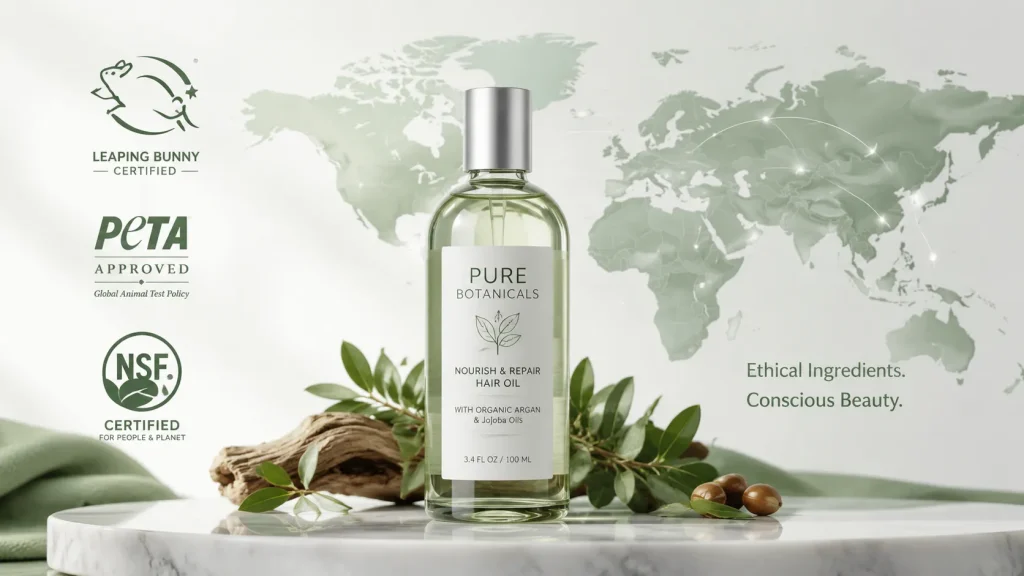
Challenges & Solutions on the Path to Certification

While benefits are substantial, the road is not without obstacles:

Challenge CategorySpecific ChallengeSolution
💼 Supply Chain ManagementGlobal, multi-tiered supply chains make ingredient traceability difficult. Small upstream suppliers may secretly conduct animal testing to cut costs.Establish supplier monitoring systems with full-chain transparency. Use contractual clauses, regular declarations, and independent audits to ensure full compliance.
💰 Cost BarriersCertification implementation (audits, management) and sourcing compliant raw materials can be expensive, pressuring startups and SMEs.Start with lower-cost, flexible certifications like PETA. Treat certification as a long-term strategic investment.
⚖️ Regulatory ConflictsSome markets still require animal testing for certain products (e.g., special-use cosmetics), conflicting with certification principles. Sticking to certification may mean forgoing those markets.Uphold ethical commitment and sacrifice certain markets if needed. Advocate for alternative methods and global policy harmonization.
🌏 Geopolitical ComplexityThe evolving policy landscape in China creates both opportunities and gray areas (see revised section below).Stay patient and monitor policy updates. Consult regulatory experts. Use compliant channels like cross-border e-commerce to enter.

The Chinese Market (Revised Section)

A Landscape of Gradual Reform and Strategic Entry

The Chinese market remains one of the most important and dynamic for global beauty brands. For cruelty-free certified brands, the situation has been evolving positively.

  • Policy Liberalization Continues – China has been steadily reducing mandatory animal testing requirements. Since 2021, imported general cosmetics (non-special-use) have been eligible for exemption from compulsory animal testing under certain conditions. In March 2026, China further released a draft proposal to reduce or waive animal testing data requirements for certain special-use cosmetics (e.g., hair perms, non-oxidative hair dyes) and products containing newly registered ingredients under monitoring, provided specific safety conditions are met.
  • Remaining Hurdles – Some special-use imported cosmetics (e.g., sunscreens, hair dyes, whitening products) still face barriers, though the 2026 draft signals future relaxation. The official language uses “reduction/exemption” rather than full “abolition,” with product safety remaining paramount.
  • New Avenues for Cruelty-Free Brands – These policy shifts have opened realistic pathways for international cruelty-free brands to enter mainland China without abandoning their ethical commitments. For example, the men’s grooming brand Bulldog became the first to maintain its Leaping Bunny certification while successfully entering the Chinese market through adjusted production strategies and compliance routes.

In summary: China is no longer an outright barrier for cruelty-free brands. While challenges remain for certain product categories, the regulatory trajectory is clearly toward alignment with global cruelty-free standards. Brands that stay informed and work with local compliance experts can now access this vast market without compromising their values.

Future Outlook: The Next Chapter for Cruelty-Free Certification

Several trends will shape the future:

  • Stricter Global Regulations – The global ban on cosmetic animal testing is expanding. From the EU’s comprehensive ban to legislation in US states and Brazil, “cruelty-free” is shifting from ethical choice to legal requirement in more jurisdictions.
  • Technology Enables Scientific Alternatives – Technological progress is the fundamental driver. 3D reconstructed human skin and computer modeling (NAMs – New Approach Methodologies) are becoming mainstream – they are not only more humane but often more accurate and efficient than traditional animal tests.
  • Harmonization of Certification Systems – Major certification bodies may increase cooperation to harmonize standards and mutual recognition, reducing the burden of multiple certifications. Combined “cruelty-free + vegan” certifications (e.g., offered by NSF) will become more common.

Summary

In conclusion, cruelty-free certification is far more than a label. It is a cornerstone for embedding ethics and long-term vision into a business model, requiring full-supply-chain transparency and strategic global navigation. For brands, choosing certification means embracing a growing market and earning consumer trust. While challenges exist, they are increasingly surmountable through innovation in technology, policy, and business models – making the path both viable and bright.

References

  1. Leaping Bunny Program – Cruelty Free International.
    Standard: full supply chain audit, fixed cut-off date, logo fee based on annual sales.
    🔗 leapingbunny.org
  2. PETA Beauty Without Bunnies – PETA.
    Two tiers: Animal Test‑Free (no animal testing, may contain animal‑derived ingredients) and Vegan (no animal ingredients).
    🔗 peta.org
  3. Choose Cruelty Free (CCF) – Choose Cruelty Free (Australia).
     Requires 100% historical no‑animal‑testing; one‑time fee of A$100.
    🔗 choosecrueltyfree.org.au
  4. NSF P543 Certification Protocol – NSF International.
    Independent certification covering ingredients, processing aids, and finished products.
    🔗 nsf.org

In This Article
Recommended Reading
A woman in a salon with coppery hair showing uneven color fading and brassy tones, illustrating how keratin treatments can shift or lift existing hair dye.

Keratin treatment can affect dyed hair color, causing fading, yellow tones, or slight darkening. Learn how to prevent color change and keep your hair looking fresh.

A young woman with a pained expression struggling to remove blue rollers from her tangled frizz hair against an orange background.

Say goodbye to "poof" and hello to glass-hair. Discover this professional blueprint for frizz control, featuring biomimetic keratin, the "180°C rule," and salon-grade sealing methods to defeat humidity for good.

Rear view of a woman with long, smooth, shiny brown straight hair against a pink background, showing healthy texture.

Discover the key differences between keratin treatments and hair rebonding to choose between temporary smoothing or permanent, poker-straight results for your unique hair type.