


When launching or expanding a professional hair care brand, product development is the most capital-intensive and time-consuming pillar of your business infrastructure. The path you select to bring your liquid assets to market shapes your financial runway, supply chain agility, and long-term brand equity.
For brand managers, independent site operators, and salon network executives, this decision invariably boils down to a fundamental choice: Stock Products (Private Label/ODM) versus Custom Formulations (Bespoke OEM).
A stock product leverages pre-developed, stability-tested formulas maintained by an Original Design Manufacturer. A custom formulation, by contrast, is a ground-up research and development (R&D) project engineered by cosmetic chemists to synthesize a completely proprietary mixture.
Understanding the financial realities and development milestones of these two paths is critical to allocating your capital efficiently and hitting critical market windows.
Before looking at specific dollar amounts and calendar weeks, you must evaluate how each manufacturing model alters your brand’s competitive advantage.
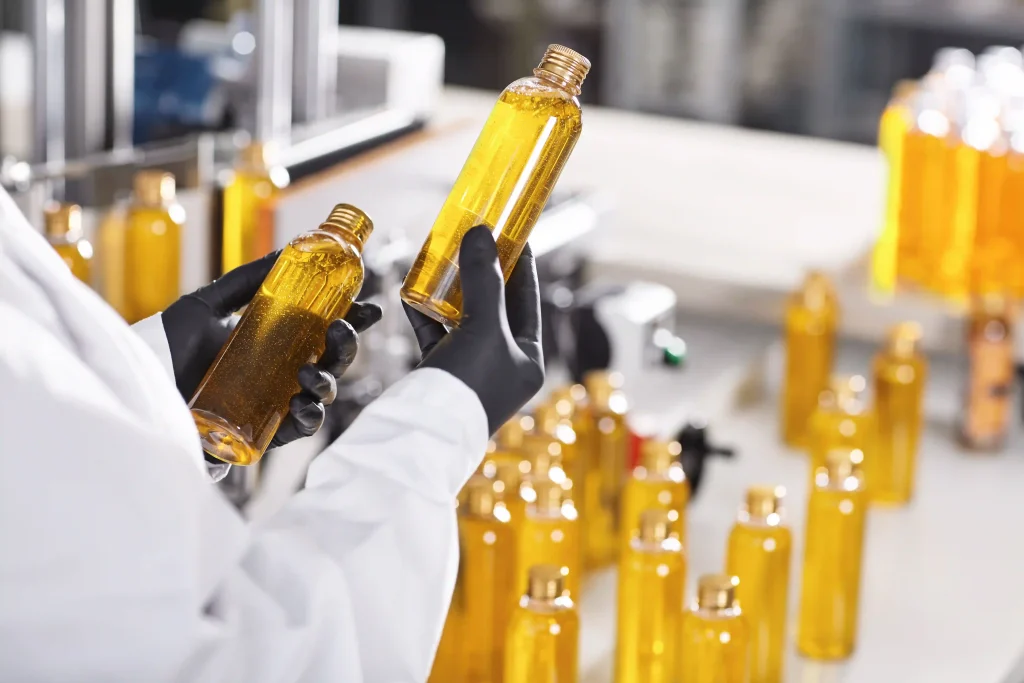
Time-to-market is often the deciding factor for trend-driven brands or agile operators looking to capture shifting consumer demands. The difference in development velocity between stock and custom routes is massive, spanning months of precision laboratory testing.
Because the product chemistry is already finalized and pre-validated for safety, the timeline drops the engineering phase entirely and focuses entirely on commercialization:
Building a unique hair care product requires a linear sequence of safety and performance milestones. Compounding a new chemical mixture means you must prove it remains stable over its entire commercial shelf life.
Briefing & First Phase Prototyping
Months 1 – 2
The brand submits a technical brief outlining target textures, performance parameters, and banned ingredient matrices. Chemists develop raw prototypes (Bench Samples) for initial sensory feedback.
Revision Loops & Feedback Iterations
Months 3 – 4
Samples undergo performance audits in the salon chair. Adjustments are made to factors like lather density, rinse-out speed, or scent retention. Each adjustment typically requires 2 to 3 weeks for re-compounding.
Mandatory Stability & Compatibility Testing
Months 5 – 7
The final formula is subjected to accelerated thermal testing (cycling between 4°C and 45°C) for 12 weeks to simulate a 2-to-3-year shelf life. Simultaneously, compatibility testing ensures the fluid does not corrode or leach plastics from your chosen packaging.
Regulatory Compliance & Documentation
Months 8 – 9
Compiling safety data sheets (SDS), executing microbial challenge testing, and registering the formulation within international regulatory frameworks (such as MoCRA in the United States or EU Portal standards).
Mass Scale-Up & Production Run
Months 10 – 12
Translating a 1-kilogram laboratory sample into a 1-ton commercial production batch. This requires pilot batch monitoring to ensure active ingredients emulsify correctly at high scale.
The financial barrier to entry varies dramatically between these two models. When calculating your initial capitalization, you must evaluate upfront development fees alongside ongoing Minimum Order Quantity (MOQ) commitments.
Because custom formulations require a manufacturer to completely halt production lines, flush piping arrays, and source unique raw components in bulk, they carry significantly higher batch thresholds.
| Financial & Operational Metric | Stock Products (Private Label / ODM) | Custom Formulations (Bespoke OEM) |
| Upfront Lab / R&D Fees | $0 – $1,500 (Basic Setup) | $5,000 – $15,000+ per SKU |
| Average Production MOQ | Low (1,000 – 3,000 units per SKU) | High (5,000 – 10,000+ units per SKU) |
| Initial Capital Runway | $5,000 – $15,000 total entry cost | $30,000 – $70,000+ per SKU |
| Long-Term Unit Profit Margin | Moderate (Capped by supplier pricing) | High (Scalable via bulk raw material purchases) |
For scaling indie beauty operations or growing salon networks, the choice does not have to be a binary compromise between high cost and lack of differentiation. The Semi-Custom Approach serves as an incredibly effective middle ground.
With semi-custom development, you select an existing, pre-validated stock base formula that already has established stability data, but you integrate targeted structural tweaks.
For instance, you might take a high-performing stock conditioning base and introduce a specific regional oil extract, modify the scent profile to match your brand theme, or swap out standard fragrance compounds for natural essential oils.
The Technical Advantage: Because the underlying emulsification system remains undisturbed, the risk of formula separation or microbial failure drops dramatically. This hybrid path cuts your lab R&D costs down to a moderate tier ($2,000–$5,000) and shortens your testing cycle to a brief 4-to-6-week compatibility validation window, while still granting you a unique ingredient narrative to showcase in your B2B marketing channels.
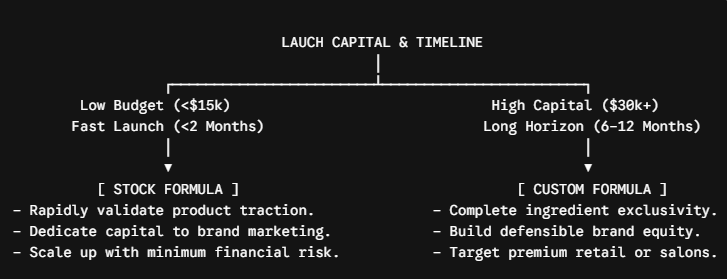
By choosing the development path that aligns with your financial runway and target retail channels, you establish a resilient product foundation that can scale seamlessly alongside your business.
Missing the right manufacturing partner to scale your line? From low-MOQ, premium stock solutions to custom brand tailoring, we handle the formulation, compliance, and filling so you can focus on the market. 👉 Get Started with Our Private Label Solutions Today